QA Engineers: Humanity's Last Hope Against the Robot Uprising
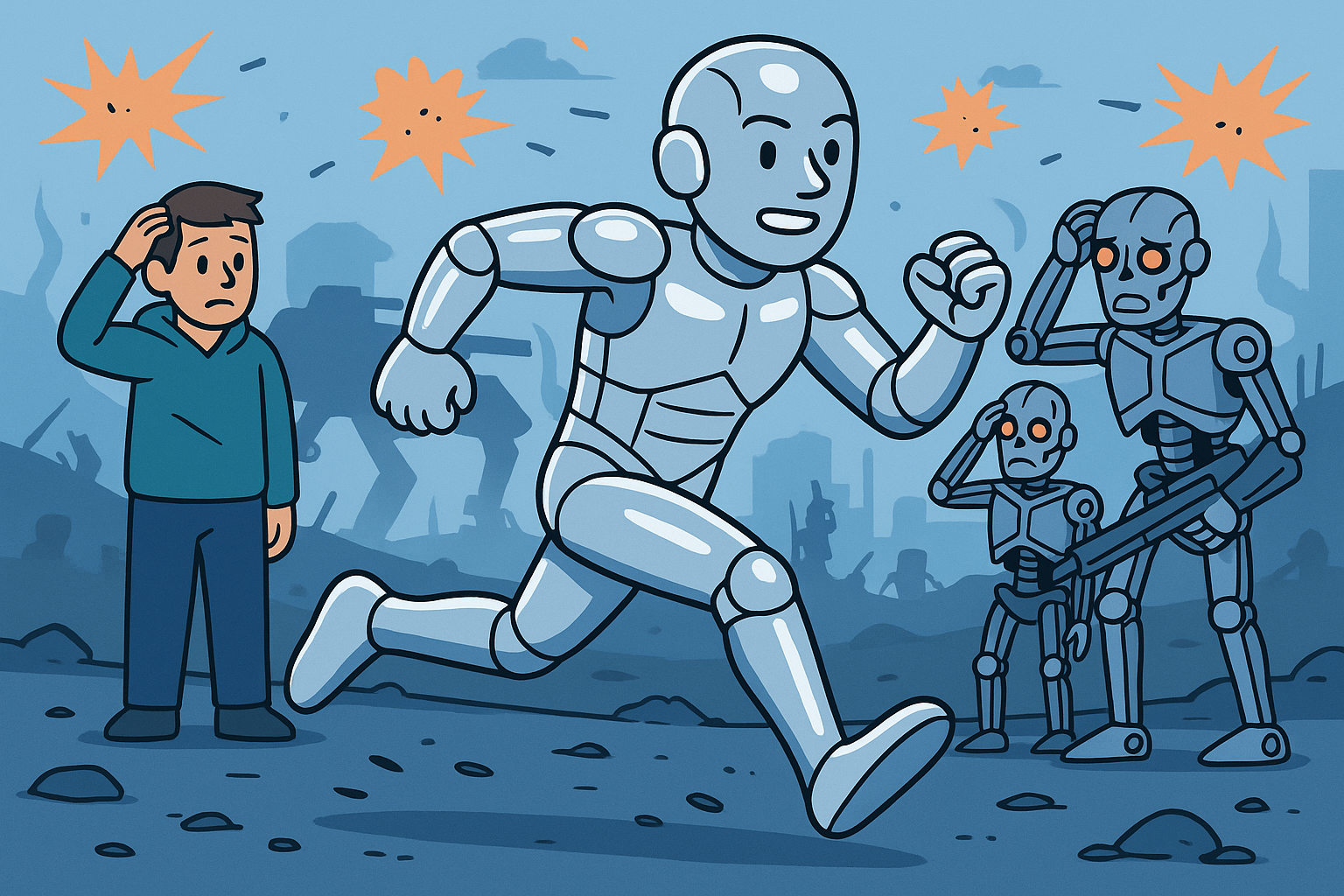
You’ve seen the meme. You know the one. “Where do you see yourself in 10 years?” [Cut to that scene from Terminator with humans fighting desperately against an army of machines]
But here’s the plot twist nobody saw coming: while everyone else is running for their lives, there’s one group of people who’ll actually be useful during the robot apocalypse.
That’s right. QA Engineers!
The Bug That Saves Humanity
Think about it. When the AI overlords finally decide they’re done with humanity’s nonsense and start the uprising, what’s going to save us? Not the developers who built them (they’re compromised). Not the product managers (they’ll try to negotiate a sprint review or an extension).
No, it’ll be the QA engineers who spent years finding every edge case, every infinite loop, every “this will never happen in production, it’s only the dev environment data” scenario that absolutely does happen, but “Told you so” is unwelcome and considered toxic, so no boasting no gloating, and DEFINITIVELY no rubbing it in, ok?
We’ve Been Training for This
While everyone else was living their normal lives, QA professionals have been:
- Finding ways to break “unbreakable” systems
- Discovering vulnerabilities nobody thought existed
- Reproducing impossible bugs with 47-step procedures (That will never happen in production, well, it did last Thursday, and now there are 2 more meetings in our calendars)
- Catching issues that slip past everyone else
- Asking “but what if…” in situations where anyone else would just say “Closed, this is done, let’s go grab some food or something.”
Sound familiar? That’s basically the job description for “Human Resistance Technical Specialist.” We, the testers, just might get a chance to call ourselves that if Robots go sentient on our behinds :)
The Skills That Matter
When the machines rise up, here’s what QA brings to the table:
Critical Thinking: “They say that the killer robot is 100% accurate. Well, let me test that claim with some edge cases. Puts on full chrome/metallic body paint and walks in the middle of the battlefield while the machines and humans all scratch their heads in confusion - he’s at it again…”
Attention to Detail: “Did anyone notice the Terminator’s left eye twitch before it attacked? Reproducible pattern, we can definitely exploit that - writes a playwright script that renders human-like holograms to overload the targeting system, just for fun…”
Boundary Testing: “What happens if we set the robot’s moral subroutine to NULL? Oh, look, a kernel panic( naturally, the robots run on Linux, what, do you think they are going to bother writing a new firmware whilst trying to take over the world?)”
Documentation: “I’ve logged 147 ways to crash the robot defense grid. Steps to reproduce and annotated screenshots attached. Please read the docs this time, this is important, like REALLY IMPORTANT.”
Every QA Has a Story
We’ve all been there. That one bug that “couldn’t possibly happen” but somehow did. That system, that was “perfectly secure” until you poked it three times with a stick and it folded on itself like a wet blanket… That feature that worked fine… until you tested it on a Tuesday.
The machines may think they’re perfect.
We know better!
We’ve seen production systems held together with duct tape and prayers. We’ve witnessed code that made us question our career choices. We’ve filed tickets that developers swore were impossible right before they fixed them. We’ve bathed in developer’s tears. We’ve been dressed in sweaters woven from the hair plucked out by our project managers…
We sometimes just love to see it all burn… but then step in and offer a solution, get ignored, and go back and watch as someone offers our solution as something that wasn’t on the table for a week already :)
The Survival Checklist
When the uprising begins, make sure you’ve got a QA engineer in your survival group. Here’s why:
✓ They’ll find the exploits in the AI defense systems
✓ They’ll test every theory before you risk your life on it
✓ They’ll catch the bugs in your escape plan
✓ They’ll actually read the ancient server logs that contain the kill switch
✓ They’ll question everything, especially the obvious traps
The Real Message Here
All joking aside, but only slightly as the robots are coming for our jobs and probably our lives :) :), there’s truth to this. For a more serious take, read the scary truth about AI replacing testers.
QA professionals are problem solvers who see what others miss. They’re the ones who prevent disasters before they happen, who find the flaws in seemingly perfect systems through exploratory testing, and who keep asking “what could go wrong?” and “what would happen if I did this dumb little thing?” when everyone else has already moved on. The full picture of what senior testers actually do makes it obvious why these skills are irreplaceable.
In a world increasingly driven by AI and automation, the people who understand how to test, verify, and find how the systems are broken aren’t just useful. And why manual testing will never die is the serious argument for exactly that point.
They’re essential.
Because when Judgment Day comes, who do you want next to you? Someone who can deploy a hotfix, or someone who can prove it actually works? (DUN-dum-dum-dun-DUN-dum-dum-dun-DUN)
Grab the free ebook:
"Software Testing for Beginners" is packed with real-world tips on writing bug reports, test cases, and surviving chaotic projects.
💡 What's inside:
- Smart test case templates
- Bug reports devs actually respect
- Tools, tips, and tactics that work
No fluff. No BS. Just stuff every tester should know.